Cyrus Moshiri, Head of Structured Credit at New Mountain Capital, joins The CLO Investor podcast to discuss how New Mountain is differentiated from other private credit businesses, if private credit is as attractive as it used to be, the risk in software industry loans, and loan default rates in general.
Like & Subscribe: Amazon Music | Apple Podcasts | Spotify
27
Apr
2026
#34, Chris York, Partner, SLR Capital
Chris York, Partner at SLR Capital, joins the CLO Investor Podcast to discuss the evolving landscape for BDCs and private credit, including publish BDC discounts, software loan risk, tender activity, and where risk-adjusted opportunities remain as the cycle matures.
Like & Subscribe: Amazon Music | Apple Podcasts | Spotify
17
Apr
2026
Why Private Credit CLOs?
April 2026
We believe private credit loan exposure can be compelling when accessed through CLOs. The CLO structure enhances diversification, defensiveness, leverage efficiency, and liquidity in ways that direct lending funds cannot easily replicate.
1. Diversification
In private credit, where individual credit outcomes can vary significantly, diversification is a powerful risk mitigant. CLOs provide investors with multiple forms of diversification:
- Broad borrower exposure: CLOs typically hold a diversified pool of senior secured loans (often 75 or more holdings).
- Industry caps: All CLOs include sector concentration limits (often around 10-15%), which may help reduce exposure to any single industry.
- Manager diversity: Allocating across multiple CLOs provides exposure to different underwriting teams, sourcing networks, and portfolio construction philosophies.
2. Defensiveness
CLOs concentrate on the conservative segment of private credit — senior secured, first-lien loans. These loans sit at the top of the borrower’s capital structure and may offer lenders certain protections in two key ways:
- First in line for repayment: These loans are generally first in line for repayment if a business faces operational challenges.
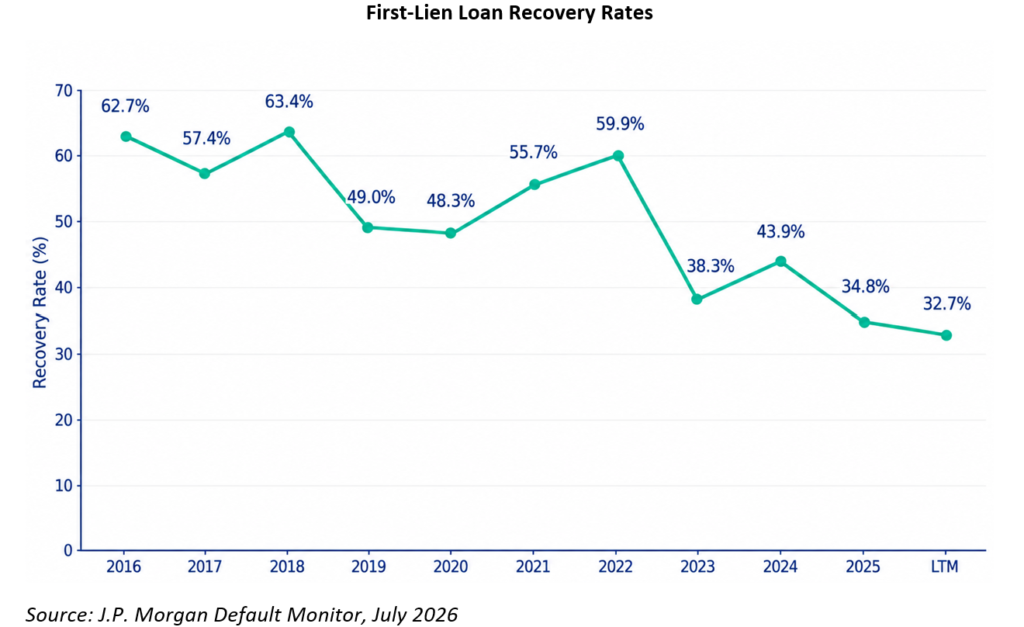
- Superior historical recoveries: Recovery rates on senior secured, first-lien loans have historically been higher than those on second-lien, unsecured, or subordinated debt that is often found in direct lending funds.
3. Leverage Efficiency
The CLO structure provides built-in leverage done on terms we believe are favorable and may be accretive to returns.
- Term-matched: Leverage is locked in for the life of the CLO, which may reduce refinancing risk.
- Non-mark-to-market: A CLO’s leverage is largely fixed at inception and is generally not contingent on changes in valuations of loans in the underlying portfolio. By comparison, many direct lending funds employ market-based financings.
4. Liquidity
CLOs are issued as securities, making them tradable and providing investors with a number of benefits when compared to direct lending funds.
- Liquidity: CLOs have an active primary and secondary market, which may enable investors to buy or sell these securities daily.
- Price discovery: Market-based pricing provides more timely transparency that is unavailable in many private credit funds.
Together, these features may make CLOs a structurally efficient and scalable way to access private credit while balancing risk, return, and liquidity.
Shiloh Bates
Chief Investment Officer
This document is intended for informational purposes only and does not constitute investment advice or a recommendation to buy or sell any security. The views expressed are subject to change and may not reflect those of all investment professionals. Past performance is not indicative of future results. Investments in CLOs involve risks, including possible loss of principal.
30
Mar
2026
#33, Drew Sweeney, Co-Head of Global Credit, TCW
Drew Sweeney, Co-Head of Global Credit of TCW, joins The CLO Investor podcast for a second time to discuss loans to software businesses at a time when AI-displacement risk is elevated. We discuss the question of if declining software valuations and cash flows will be severe enough to impair first lien loans.
Like & Subscribe: Amazon Music | Apple Podcasts | Spotify
17
Mar
2026
#32, John Kim, CEO and Co-Founder, Reckoner Capital
John Kim, CEO and Co-Founder of Reckoner Capital, joins The CLO Investor podcast to discuss the launch of innovative CLO ETFs, including leveraged and reinvesting structures. The conversation also covers broader trends in the CLO market, risk considerations, and how institutional and retail investors may think about CLO debt today.
Like & Subscribe: Amazon Music | Apple Podcasts | Spotify
06
Mar
2026
Captive CLO Equity Funds with Shiloh Bates
Captive CLO Equity Funds
One structural challenge for CLO equity investors in the years ahead is the growing prevalence of captive CLO equity funds, which purchased a substantial majority of the equity in CLOs created last year.
A third party CLO investor is not tied to deals from one CLO manager. Rather, they seek attractive risk-adjusted returns across an investible universe of 3,000 CLOs managed by 190 managers1. That could include new issue CLOs, secondary market CLOs, mezzanine debt, and warehouse positions.
By contrast, captive CLO equity funds typically invest exclusively in the next several deals of a single CLO manager. A captive fund participating in four new CLOs would represent a small fraction of the broader CLO market and would be concentrated in transactions managed by a single CLO manager. A public-equity analogue would be a fund that invests only in the next few IPOs underwritten by a single investment bank, irrespective of valuation or business model.
Certain newly issued CLOs in 2025 featured projected equity returns that were materially lower than those available through comparable secondary-market investments. Importantly, CLO managers earn management fees when new CLOs are created, regardless of the projected returns to equity investors. In our view, this structure may create potential incentive misalignment between CLO managers and captive equity fund investors.
The impact of captive equity issuance extends beyond individual CLOs. By supporting CLO formation at suboptimal projected equity returns, we believe that captive funds increase demand for leveraged loans, contributing to tighter loan spreads. At the same time, elevated CLO issuance places upward pressure on CLO financing costs. The combination reduces CLO equity profitability across the market. While captive equity funds are attractive businesses for CLO managers and bankers, their proliferation has weighed on returns for CLO equity investors more broadly.
Captive CLO equity funds are often marketed on the basis of access to a scarce asset — namely, the manager’s own CLOs — and the promise of lower fees. In my experience, truly constrained access to primary CLO equity opportunities is rare. CLO management is fundamentally an assets-under-management business, and broadly syndicated CLO managers typically find ways to accommodate new capital when economic incentives align.
The lower fee argument also warrants scrutiny. While captive funds may advertise discounted CLO management fees, such fees have long been heavily negotiated across the industry, and the broader trend has been downward. It is true that captive equity fund investors avoid the incremental fund-level expenses charged by third-party CLO equity investors. However, those savings come at the cost of limited investable universe and reduced portfolio diversification.
Two questions investors may wish to ask captive CLO equity fund managers are:
- Would the CLO equity recently issued have been attractive to non-captive CLO equity investors?
- If the portfolio were marked-to-market using recent secondary-market trades, what would be the fund’s current fair value?
The word ‘captive’ is defined by the Meriam Webster dictionary as something or someone taken prisoner. In the case of captive equity funds, it’s not clear if the prisoner is the Fund’s investors or the entire CLO market.
Shiloh Bates
CIO, Flat Rock Global
1. Source: Bank of America Global Research, CLO Market Research/Chartbook, Patrik Gupta
This commentary reflects the views of Flat Rock Global as of the date indicated and is subject to change. The information provided is for informational purposes only and does not constitute investment advice of an offer to buy or sell any security. Past performance is not indicative of future results. Investments in CLO equity involve significant risks, including market risk, credit risk, structural risk, and potential loss of principal.
23
Feb
2026
#31, Serhan Secman, Global Head of CLOs, Napier Park
Serhan Secman, Global Head of CLOs at Napier Park, joins The CLO Investor podcast to discuss the CLO investing business, inefficiencies in the market and the three factors that negatively effected CLO equity in 2025.
Like & Subscribe: Amazon Music | Apple Podcasts | Spotify
10
Feb
2026
27
Jan
2026
#30, Shiloh Bates, 2025 CLO Recap
Shiloh Bates, the Chief Investment Officer of Flat Rock Global, provides a concise recap of the 2025 CLO market. This episode breaks down record issuance, strong CLO debt performance, and the headwinds that weighed on CLO equity.
Like & Subscribe: Amazon Music | Apple Podcasts | Spotify
TRANSCRIPT
Hi, I’m Shiloh Bates, and welcome to the CLO Investor Podcast. CLO stands for Collateralized Loan Obligations, which are securities backed by pools of leveraged loans. In this podcast, we discuss current news in the CLO industry, and I interview key market players.
Two housekeeping notes:
I’m always looking for interesting guests to have on the podcast. Email us at info@flatrockglobal.com if you’d like to come on.
I recently created a CLO 101 video that is 12 minutes long, and has all the basics you need to know about CLOs. You can find it on YouTube. Let me know what you think.
*****
Today’s podcast is a short recap of 2025 for the entire CLO market. Now, of course, the investors in Flat Rock funds get a different update – and our portfolios are often positioned distinctly from the wider CLO universe, especially given our focus on private credit CLOs.
By some metrics 2025 was a good year for the CLO market. CLO new issuance of $200 billion hit record levels, while refinancings and resets added another $320 billion of issuance, also a record. Given the general lack of profitability of newly issued CLOs in 2025, the equity was largely purchased by captive CLO equity funds, whose mandate apparently excludes secondary market purchases, which offered more attractive risk-adjusted returns in 2025, that’s my opinion anyways.
Palmer Square has very helpful CLO indices that show CLO AAA returned of 5.6% for the year, and CLO BBs returned about 9%. The [CLO] BB default rate was de minimis at 35bps. In other words, if you owned CLO debt in 2025, the experience was largely positive and uneventful, though declining spreads and base rates (SOFR), resulted in returns lower than in 2024.
For CLO equity, performance was not favorable. According to Bank of America Research, CLO equity posted a negative five percent total return for the year. Strong CLO debt performance and weak CLO equity performance was the result of several forces all converging at the same time.
In my experience, most CLO equity investors underwrite to a base-case loan loss assumption of around 60bps per year. And additional loan loss reserves are taken for loans trading at discounts.
At the end of 2025, the default rate on leveraged loans in CLOs was 2.8%, and recoveries hovered around 50%. That translates to loan losses of 140bps, more than double what many investors would typically reserve for.
Loan defaults weren’t concentrated in a single industry. Defaults came from capital structures put in place during the zero-interest-rate period of 2020 and 2021. Loans are floating rate, and as rates rose beginning in 2022, corporate interest burdens increased materially. Companies that also faced operational challenges — be it from customer attrition, regulatory changes, or technological disruption — struggled with what became years of higher rates. The resulting defaults weighed on CLO equity performance. Fortunately, while higher loan defaults were materially negative for CLO equity they generally were not bad enough to impair CLO BBs, in my opinion.
One misconception in 2025 was that defaults were largely a media phenomenon and a handful of high-profile bankruptcies like First Brands and Tricolor making headlines while underlying credit conditions remained benign. But that misses an important point.
In-court loan restructurings (that’s Chapter 11) were not especially elevated in 2025. Out-of-court restructurings, however, accounted for roughly 60% of loan default activity. In the CLO market, these are referred to as Liability Management Exercises (LMEs). And from the perspective of CLO equity, the distinction between in court and out of court doesn’t really matter. Any loan restructuring that reduces contractual interest or principal from a borrower represents a real economic loss for the CLO.
For private credit loan CLOs the a performance benchmark is the Cliffwater Direct Lending Index, which reported losses of about 60bps for the year ended September 30, which could actually make for a good year in CLOs. But private default rates benefit from what I call a growing denominator problem. Assets under management in private credit are expanding rapidly, and newly originated loans rarely show stress early in their lives. A loan originated today may default in 2-3 years but would rarely default before that. The default rate is simply defaulted loans divided by assets under management. And a steady increases in the denominator can mask credit issues in the underlying loans for years. Said a different way, if private credit total assets began to shrink, I’d expect to see a much higher default rate than the one reported in the Cliffwater Direct Lending Index. CLOs, by contrast, are largely fixed pools of assets. They don’t get the cosmetic benefit of AUM growth masking any loan deterioration.
The second challenge for CLO equity in 2025 was declining cash flows.
One of the most attractive features of CLO equity is what I call the self-healing mechanism. During periods of stress loan defaults pick up and that’s negative for the CLO, but at the same time performing loans may be trading at a discount. CLOs can then reinvest any loan repayments into discounted assets that most likely will repay at par, increasing CLO equity returns.
That mechanism was largely absent in 2025. There was a brief volatility spike in April around what some called “Liberation Day” but for most of the year, loan prices remained stubbornly high. That’s because demand for leveraged loans was strong, while LBO activity was muted. As a result, CLOs had little opportunity to buy discounted assets. Worse still, loan borrowers were often able to refinance their loans at lower spreads, reducing interest income into CLOs.
Declining asset spreads aren’t necessarily a problem for CLO equity if financing costs decline at the same rate. And as I already mentioned, 2025 set a record for refinancings and resets, many of which I assume were highly accretive for equity returns.
But timing matters.
CLO liabilities typically have two-year non-call periods. Leveraged loans, on the other hand, often have non-call periods of six months or less. Asset spreads compressed faster than financing costs could adjust, and that mismatch further pressured cash flows in 2025. Adding insult to injury. CLO equity valuations moved lower during the year.
At a time when the S&P 500 was hitting record highs and credit spreads were near historic tights, CLO equity traded at what I believe to be a material discount. A selling point for CLO equity has been it’s lack of correlation to the S&P 500, however nobody likes to be uncorrelated when other markets are up.
When I began investing in CLO equity in 2018 at Flat Rock, base-case return targets were around twelve percent. By the end of 2025, comparable investments were underwriting to roughly sixteen percent returns. The increase in targeted IRRs came primarily from lower prices.
What made last year especially challenging is that all three headwinds, higher defaults, weaker cash flows, and lower valuations arrived simultaneously. Each one on its own is manageable but three together make for… a tough year.
So where does that leave us heading into 2026?
Fortunately, there’s a few reasons for optimism in 2026.
Last year, SOFR declined from 4.3% to 3.7%, and further declines are expected this year. Lower base rates reduce interest burdens for borrowers and should ease loan pressure. Lower SOFR encourages LBO activity by improving acquisition economics, and we’re already seeing a pick-up in LBO activity.
More loan creation would likely widen loan spreads, while CLO financing costs are not expected to increase, a favorable dynamic for equity.
And finally, there’s the math of time.
CLO equity generates substantial quarterly distributions over an eight-plus-year projected life before liquidation – you don’t have to wait indefinitely for your return to be realized. Today, the market discounts future CLO equity cash flows at high rates. As time passes, discounted cash flows become realized cash flows. And if realized cash flows match projections, CLO equity values should increase. Additionally, cash flows received from CLOs today can be reinvested into today’s higher return opportunity market.
So again, lower base rates (that’s SOFR), increased LBO activity and a normalization of market rates of the return have the potential to make 2026 a very profitable year.
The closing question I always my podcase guest is “Describe a CLO in 30 seconds?” The correct answer is a CLO is simplified bank, whose assets are a diversified portfolio of first lien loans. The simplified bank finances itself by issuing debt and equity securities with different payment priorities. The bank’s profitability is generated from assets that pay a higher rate than the CLO’s financing cost. The result of 30 years of favorable CLO performance is an asset class today of $1.1 trillion.
In the next episode I’ll be back in the usual format, interviewing one of the CLO markets key players.
If you’re enjoying the podcast, please remember to share, like and follow.
Disclosure AI:
The content here is for informational purposes only and should not be taken as legal, business tax or investment advice, or be used to evaluate any investment or security. This podcast is not directed at any investment or potential investors in any Flat Rock Global Fund.
Definition Section:
– Secured overnight financing rate SOFR is a broad measure of the cost of borrowing cash overnight, collateralized by Treasury securities.
– The global financial Crisis GFC was a period of extreme stress in the global financial markets and banking systems between mid-2007 and early 2009.
– Credit ratings are opinions about credit risk for long term issues or instruments. The ratings lie in a spectrum ranging from the highest credit quality on one end to default or junk on the other. A AAA is the highest credit quality, a C or a D, depending on the agency, the rating is the lowest or junk quality.
– Leveraged loans are corporate loans to companies that are not rated investment grade.
– Broadly syndicated loans are underwritten by banks, rated by nationally recognized statistical ratings organizations, and often traded among market participants.
– Middle market loans are usually underwritten by several lenders, with the intention of holding the instrument through its maturity.
– Spread is the percentage difference in current yields of various classes of fixed income securities versus Treasury bonds, or another benchmark bond measure.
– A reset is a refinancing and extension of a CLO investment period.
– EBITDA is earnings before interest, taxes, depreciation and amortization. An add-back would attempt to adjust EBITDA for non-recurring items.
– LIBOR, the London Interbank Offer Rate, was replaced by SOFR on June 30th, 2024.
– Delever means reducing the amount of debt financing.
– High yield bonds are corporate borrowings rated below investment grade that are usually fixed rate and unsecured.
– Default refers to missing a contractual interest or principal payment.
– Debt has contractual interest, principal and interest payments, whereas equity represents ownership in a company.
– Senior secured corporate loans are borrowings from a company that are backed by collateral.
– Junior debt ranks behind senior secured debt in its payment priority.
– Collateral pool refers to the sum of collateral pledged to a lender to support its repayment.
– A non-call period refers to the time in which a debt instrument cannot be optionally repaid.
– A floating rate investment has an interest rate that varies with the underlying floating rate index.
– RMBS are residential mortgage-backed securities.
– Loan to value is a ratio that compares the loan amount to the enterprise value of a company.
– GLG is a firm that sets up calls between investors and industry experts.
– Payment In Kind, or PIK, refers to a type of loan or financial instrument where interest or dividends are paid in a form other than cash, such as additional debt or equity, rather than in cash
– A covenant refers to a legally binding promise, or lender protection, written into a loan agreement.
– Net Asset Value (NAV) – The value of a fund’s assets minus its liabilities, typically used to determine the per-share value of an interval fund or investment vehicle.
– Dividend Recapitalization (Dividend Recap) – A refinancing strategy where a company borrows to pay a dividend to its shareholders, often used by private equity sponsors.
– Continuation Vehicle – A fund structure that allows investors to roll their interest in an existing portfolio company into a new vehicle, while offering liquidity to those who want to exit.
– Equity Cure – A provision that allows private equity sponsors to inject equity into a company to fix a financial covenant breach.
Risks:
– CLOs are subject to market fluctuations. Every investment has specific risks, which can significantly increase under unusual market conditions.
– The structure and guidelines of CLOs can vary deal to deal, so factors such as leverage, portfolio testing, callability, and subordination can all influence risks associated with a particular deal.
– Third-party risk is counterparties involved: the manager, trustees, custodians, lawyers, accountants and rating agencies.
– There may be limited liquidity in the secondary market.
– CLOs have average lives that are typically shorter than the stated maturity. Tranches can be called early after the non-call period has lapsed.
General disclaimer section:
Flat Rock may invest in CLOs managed by podcast guests. However, the views expressed in this podcast are those of the guest and do not necessarily reflect the views of Flat Rock or its affiliates. Any return projections discussed by podcast guests do not reflect Flat Rock’s views or expectations. This is not a recommendation for any action and all listeners should consider these projections as hypothetical and subject to significant risks.
References to interest rate moves are based on Bloomberg data. Any mentions of specific companies are for reference purposes only and are not meant to describe the investment merits of, or potential or actual portfolio changes related to securities of those companies, unless otherwise noted. All discussions are based on U.S. markets and U.S. monetary and fiscal policies. Market forecasts and projections are based on current market conditions and are subject to change without notice. Projections should not be considered a guarantee. The views and opinions expressed by the Flat Rock Global Speaker are those of the speaker as of the date of the broadcast, and do not necessarily represent the views of the firm as a whole. Any such views are subject to change at any time based upon market or other conditions, and flat Rock global disclaims any responsibility to update such views. This material is not intended to be relied upon as a forecast, research or investment advice.
It is not a recommendation, offer or solicitation to buy or sell any securities or to adopt any investment strategy. Neither Flat Rock Global nor the Flat Rock Global speaker can be responsible for any direct or incidental loss incurred by applying any of the information offered. None of the information provided should be regarded as a suggestion to engage in, or refrain from any investment-related course of action, as neither Flat Rock Global nor its affiliates are undertaking to provide impartial investment advice. Act as an impartial adviser or give advice in a fiduciary capacity. Additional information about this podcast, along with an edited transcript, may be obtained by visiting flatrockglobal.com.
21
Jan
2026
CLO Equity in 2025 with Shiloh Bates
Shiloh Bates, Flat Rock Global’s Chief Investment Officer, was interviewed by CreditSights to discuss why CLO equity underperformed in 2025. In the interview, he explains how elevated loan defaults, declining asset spreads, and higher required return assumptions combined to pressure CLO equity returns, while emphasizing that these challenges were cyclical rather than structural. Bates also shares why he believes the outlook for 2026 is more favorable, citing improving rate dynamics, the potential for increased LBO activity, and a possible attractive forward return environment for long-term investors.